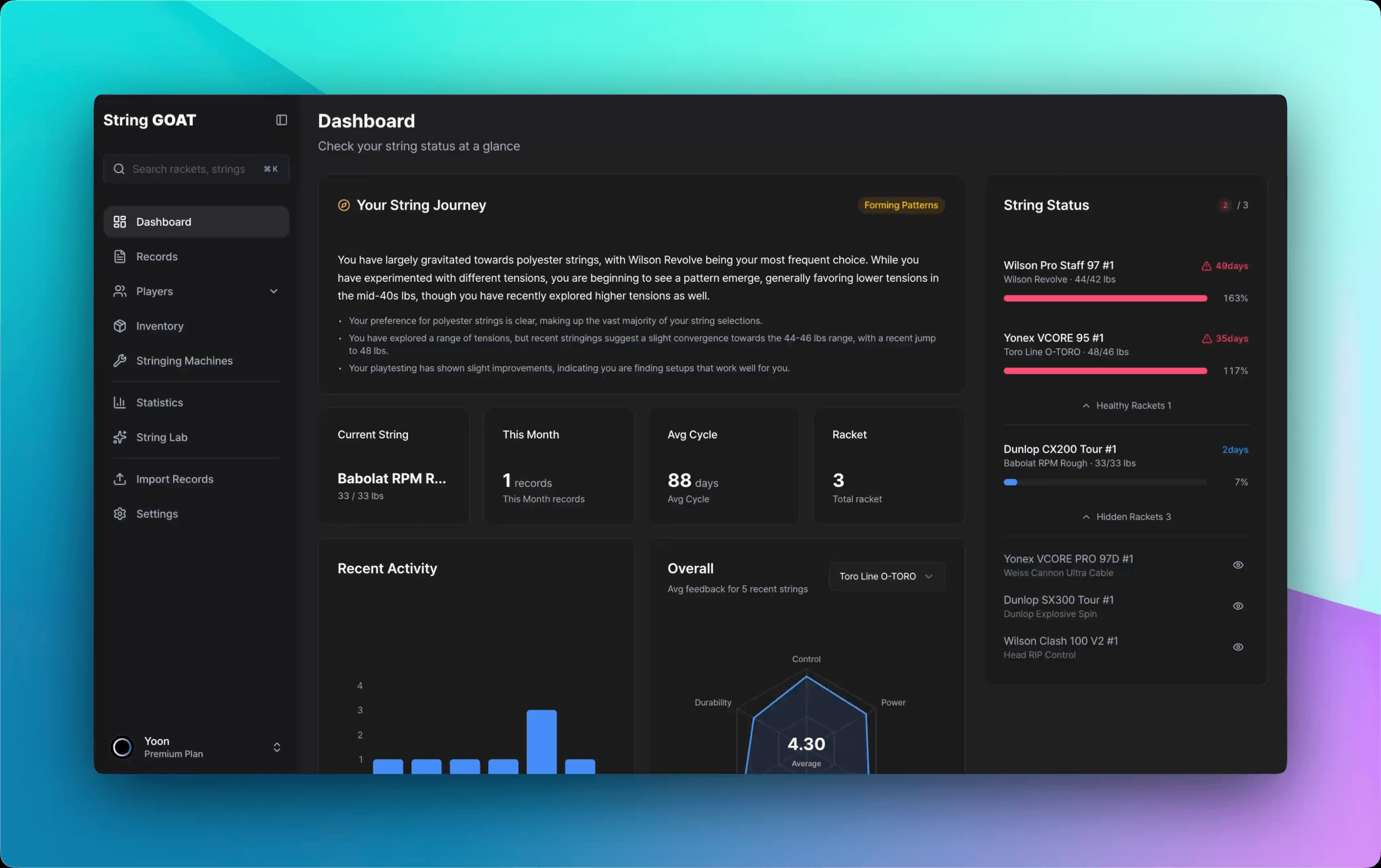
String GOAT for Tennis Home Stringers: Track Every Restring, Reel & Tension in One App
"How much string is left on this reel?"
If you've been home stringing for more than six months, you've asked yourself this. You bought that reel just a few weeks ago, but you have no idea how many restrings are left on it. You can't remember whether last time was 48 lbs or 50. You're not even sure what string is currently on this racket.
None of this came up when you used a pro shop. Pay, pick up, play. The moment you start home stringing, a flood of new variables appears: which reel has how much left, which racket got which setup, what worked and what didn't.
You start with a Notes app or a spreadsheet. Three months in, the data starts falling apart. Six months in, you can't answer a basic question like "what did I put on this racket last fall?"
The real challenge of home stringing isn't operating the machine — it's data management.
Why People Become Home Stringers
Home stringing (or self-stringing) is the practice of stringing your own rackets on a personal machine. The community calls them "home stringers." Most fall into the hobby for one of three reasons.
First, cost. A pro shop restring runs $30–60 in the US, depending on the string. Restring once a month, play 2–3 times per week, and you're spending $360–720 per year on stringing alone.
Home stringing changes the math entirely. A standard 200m reel costs roughly $40–150 depending on the string. One adult mid-plus racket (98–100 sq in) consumes about 12 meters per restring, so a full reel yields around 16–17 restrings. Material cost per job drops to $3–9.
Factor
Pro Shop
Home Stringing
Cost per restring
$30–60
$3–9 (materials only)
Scheduling
Shop hours
Whenever you want
Tension control
Request-based
Direct, 0.5–1 lb increments
Upfront cost
None
Stringing machine
Same-day availability
Depends on shop
String it now, play tonight
Second, freedom. Want to experiment with tension in 1–2 lb steps? Asking your local shop to do that every time isn't realistic. Home stringers can string at 50 today, drop to 48 tomorrow, and feel the difference back-to-back. New racket arrives at noon? Strung by dinner.
Third, experimentation. Trying different strings to find what fits your game becomes a hobby in itself. Hybrid setups — poly mains, multi crosses — are practical only when you can string them yourself without paying double.
If you bought an entry-level drop-weight machine ($150–350), the break-even is simply machine price ÷ savings per restring. With this article's figures ($30–60 at a shop, $3–9 in materials) that lands anywhere from a few months to about a year at 2–3 restrings a month — the spread is wide because machine prices and shop rates vary just as much.
The Realization That Hits Around Month Three
The first few restrings are exciting. There's a real satisfaction in stringing your own racket, and the cost savings feel tangible. Your first racket took two hours, you had to unweave a misweave, you cut a cross too short and wasted a length, and a slipping clamp left one or two rackets with uneven tension. It's all part of the learning curve. After 5–10 jobs, you're closing out a racket in 30–40 minutes.
But once five or ten jobs have stacked up, a different question shows up — not at the machine, but on the court.
"I'm pretty sure last time felt better… but what was it?"
If you don't record what tension, string, and racket combination was on each job, and how it actually played, you can't answer that question. The whole point of doing it yourself — building your own data, dialing in your optimal setup — evaporates the moment your impressions disappear.
This is when the real challenge of home stringing becomes clear: you need a system that converts experience into data.
Start free with String GOAT
As your records build up, AI picks your next string setup
The five categories home stringers need to log consistently are: restring history, reel inventory, tension experiments, string lifespan patterns, and cumulative cost. Skip one or two, and the data stops turning into insight.
1. Restring History
Which racket, which string, what tension, when. Without these four data points, you have no baseline to improve from. "Last setup felt better" is a memory — not a data point.
2. Reel Inventory
When you buy a 200m reel, you need to know when to reorder before you run out. This becomes critical when you're juggling multiple reel types or stringing for friends and clubmates. Running out mid-season — or worse, mid-promise — is avoidable.
3. Tension Experiments
The same string at 46 lbs and 52 lbs feels completely different. Most players narrow down their ideal range by experimenting in 2 lb increments. Without recorded results, you're starting from scratch every cycle and "I think last time was better" loops forever.
4. String Lifespan Patterns
The same string lasts wildly different durations for different players. A heavy topspin hitter notches polyester within five hours of play; a control player can stretch the same string past fifteen. Polyester typically "goes dead" somewhere in the 2–20 hour range, and the signal isn't just notching — a board-like feel, less spin grip with the ball flying longer than usual, and a sudden jump in unforced net or out errors all point to the same thing. The pro shop default of "every month" is too late for some, way too early for others. The accurate replacement window only emerges from your own data.
5. Cost Tracking
Cost per reel, cost per restring, cumulative savings versus pro shop pricing. Numbers keep you motivated, and they tell you exactly when the machine has paid for itself.
When Spreadsheets and Notes Apps Break Down
The first tool every home stringer reaches for is a spreadsheet or the Notes app. Build columns, log dates, enter tensions. It works for the first ten restrings. Then your spreadsheet has five tabs, or your notes scatter across hundreds of entries.
Logging feedback on-court is awkward. Right after a match, when impressions are sharpest — your laptop's at home and mobile spreadsheet entry is painful.
Reel inventory and restring history don't talk to each other. Two separate sheets, manually maintained. Update one, forget the other.
Searching gets slower as data piles up. "What did I put on this racket last month?" becomes a 30-second hunt instead of a quick lookup.
No patterns emerge. The numbers exist, but insight doesn't. "Did I score control higher at 48 or 50?" requires sorting and filtering, not a glance.
Notes apps are searchable but only chronological — they can't answer "what's currently on this racket." Photos of the machine display are even worse: visual proof, zero analytics, no comparison.
What home stringers actually need is a system where "racket → string → tension → feedback → time" connects automatically.
How String GOAT Solves It
String GOAT is built around the five tracking problems home stringers actually face.
Faster on the Second Entry
Your first entry asks for racket details (brand, model, head size, string pattern, etc.) and string details (brand, model, gauge). From the second job onward, your previous racket, string, and tension values auto-suggest, so you only confirm what changed. Independent main and cross tension fields handle hybrid setups directly.
After logging, rate the setup across six dimensions — power, control, spin, comfort, feel, durability — directly from your phone with sliders. Best done right after a match, while impressions are sharpest.
Automatic Reel Deduction
Register a reel and select it when logging each restring. The app deducts the meters used and shows remaining capacity (in meters or remaining jobs). Get notified when a reel is almost out. Manage multiple reel types simultaneously — useful when you're running a poly main reel, a multi cross reel, and a backup hybrid setup all at once.
Tension History Visualization
Compare feedback scores across tension settings for the same string. After 3–5 restrings, patterns become visible: "I scored highest on control at 48 lbs with this poly" appears as a clear chart, not a guess.
Automatic Cost Calculation
Log the purchase price when you register a reel and every reel's spend lives in one place; each job auto-deducts the remaining length, so you always know how many restrings a reel has given you. With those two numbers, cost per restring and savings versus the pro shop are a quick back-of-the-envelope calculation.
Take a quick walk through the dashboard. The clip steps through restrings, rackets, players, inventory, and stats — the full home stringer workflow at a glance.
String GOAT web dashboard — a menu-by-menu walkthrough.
The Science Behind Tension Experiments
Polyester strings shed tension fastest the moment they go in — up to 15 lbs in one minute and as much as 20 lbs in the first 20 hits on TWU's test machine — and "go dead" somewhere in the 2–20 hour range (TWU relaying common lore, a tenfold spread). Home stringers tend to hit a surprise the first time they look at a tension chart — polyester loses meaningful tension within the first day. This is a physical phenomenon called polymer creep, and it's why a poly setup feels stiff right off the machine, then noticeably different the next day (Tennis Warehouse University: Why Strings Go Dead).
That's why getting to know a string deeply takes more than one impression. There's a window where the feel changes day to day, then a settled stretch, then a final stretch where notches deepen and breakage shows up. Logging that arc on paper instead of in your head is what separates serious home stringers from the rest.
For example, string a poly at 50 lbs and follow this:
Right off the machine — log tension, date, reel
First session (within 24–48 hours) — capture initial impressions as a quick note
Settled state (after 5–10 hours of play) — rate all six dimensions on the sliders
At replacement — close out on breakage or notch depth, log total hours played
Next time, string the same poly at 48 lbs and follow the same flow. The two jobs sit side by side in your feedback. What emerges isn't just an "ideal tension" — patterns like "this string plays best between days 3 and 10" become visible too. The biggest asset a home stringer accumulates is the same string strung at different times, tensions, and rackets, and its value lives in comparison, not in impressions.
Why AI Recommendations Hit Different for Home Stringers
Spend any time on a tennis forum or subreddit and you'll see the same threads: "What tension for this racket?" "Recommend a string for me." Each thread gets dozens of replies, and the answers split five ways. The reason is simple — tension and string fit depend on swing speed, racket, surface, conditions, and personal feel. Someone else's best is rarely yours.
Home stringers are uniquely positioned to solve this. Restring 2–4 times a month with deliberately varied tensions and strings, and your data is structured by design. Casual players repeating the same setup once a month don't have a comparison set. Home stringers do — their experiment data is rich and structured.
String GOAT's AI takes your restring and feedback data straight in as the input. Sparse data yields generic answers; rich logs of varied tensions plus six-slider feedback push the recommendation toward your specific pattern: "this user scored highest on control with poly around 48 lbs." The home stringer's experiment volume becomes the lever for recommendation quality.
For a home stringer, AI recommendations aren't a gimmick — they're a compression of dozens of your own controlled experiments. Curious how the engine works? Read How String GOAT's AI Recommendation Works.
Stringing for Friends and Club Members
There's a moment when one home stringer becomes the unofficial stringer for an entire club. Tennis clubs, leagues, and lesson groups gather regularly, and inside that circle whoever owns a machine starts getting asked for favors. It begins as no-charge stringing for a friend, then turns into a regular informal service — and these home stringers run quietly active sub-communities of their own.
The list of things to track explodes:
Who prefers which tension and string
When each person was last strung
Which racket each person uses (model, head size)
Cost recovery, material accounting, money owed
String GOAT Premium supports player (customer) management. You can register each person separately and track their racket and string history independently — practical for anyone running an informal service from their home setup.
Getting Started
The earlier you start logging, the bigger the efficiency gap becomes. Whether you're already home stringing or thinking about buying your first machine, set up a tracking system before anything else. No matter how much you saved on the machine, finding your optimal setup without recorded data takes far longer.
What we recommend when you start logging:
Log from job one — string name, tension, racket, date, every time
Rate all six feedback dimensions — power, control, spin, comfort, feel, durability
Record replacement events — breakage or notching that prompted a restring
Change one variable at a time — vary tension in 1–2 lb increments or hold tension and swap strings, so the data stays comparable
Use AI recommendations as data builds up — the more restrings and feedback you log, the closer the suggestions get to your specific pattern
String GOAT is free to start.
Start free with String GOAT
As your records build up, AI picks your next string setup