Roger Federer spent roughly $40,000 a year on Priority 1, a dedicated stringing service. Ron Yu, his personal stringer since 2004, traveled to every Grand Slam and Masters event, stringing 9 fresh rackets per match — about 70,000 rackets over his career — to maintain absolute setup consistency. Rafael Nadal has a dedicated tournament stringer reproducing the exact same setup on a single machine every time. For professionals, string management isn't optional — it's routine.
Of course, recreational players don't need a $40,000-a-year stringing service. But the reason pros invest that much — setup consistency and data-driven management — applies equally to club players and juniors. It's not about expensive services; it's about the habit of tracking. The data that habit builds is where your personal insights come from. For junior players especially, developing the discipline of systematic recording during their formative years becomes a long-term asset.
Of course, fundamentals and training matter most. Changing strings won't add 20 km/h to your serve. But at the same skill level, finding your ideal equipment setup through data versus picking by feel every time makes a real difference. This article isn't about replacing fundamentals — it's about one habit you can build on top of them.
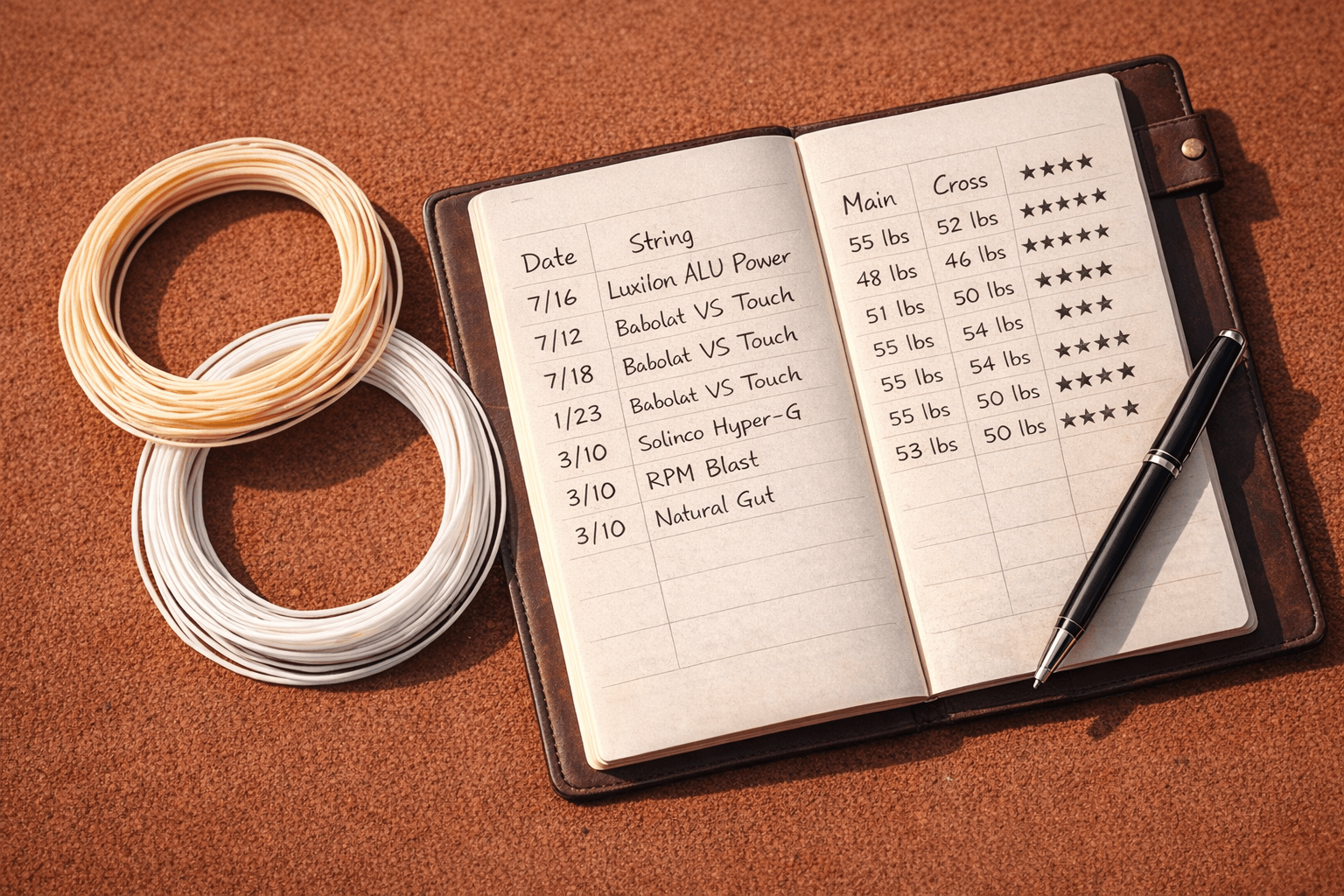
A string log notebook — recording dates, products, tensions, and ratings reveals patterns
Yet almost no recreational players track their strings systematically. They say "same as last time, please" but can't remember exactly what was strung or at what tension. And they keep asking, "It felt great before — why is it different now?"
This article explains why you should track your strings, backed by scientific evidence. Research shows why data matters more than feel.
What Gets Measured Gets Changed — The Science of Self-Monitoring
One of the most powerful principles in behavioral science is that "what gets measured gets changed."
According to Burke et al.'s (2011) systematic review in the Journal of the American Dietetic Association, self-monitoring is one of the strategies most consistently associated with behavior change. Track your diet, and eating habits shift. Track your workouts, and exercise frequency increases. The act of recording itself changes awareness, and changed awareness leads to different choices.
The same applies to sports. Athletes who keep training journals recognize their strengths and weaknesses more accurately and adjust their training direction more effectively. In sports psychology, this is called reflective practice, and the principle that systematic recording and review contributes to performance improvement is widely accepted.
String tracking works on the same principle. The moment you record "this string had great power / lacked spin / hurt my arm," your next string choice becomes a decision, not a guess.
Memory Is Unreliable — Why Feel Isn't Data
We trust our memories, but memory is surprisingly inaccurate.
According to Nobel laureate Daniel Kahneman's research, humans don't remember entire experiences — they remember the most intense moment (peak) and the final moment (end). This is the peak-end rule.
Applied to tennis:
- Hit a service ace in the last game and you'll remember "these strings are great" — even if balls were flying out the rest of the time.
- Hit the net a few times in the final game and you'll remember "these strings are bad" — even if the overall session was good.
When you choose your next strings based on distorted memories, you end up abandoning setups that worked and repeating ones that didn't. Records correct this distortion. Leave specific feedback right after playing, while memory is fresh — and three months later you still have accurate evidence for your decisions.
3 Reasons Tracking Matters Especially for Strings
1. Tension Changes Every Day
From the moment strings are installed, tension starts dropping. The loss is steepest at the start — up to 15 lbs in one minute and as much as 20 lbs over the first 20 hits on TWU's test machine — and it keeps declining after that (see our poly replacement guide). The same string 3 days after stringing and 3 weeks after stringing is essentially a different string.
With a stringing date in your records, you can trace back "how old the string was when it felt this good." That becomes data for replacement timing.
2. Huge Variation Between Products of the Same Material
Even within polyester alone, stiffness across products in the TWU (Tennis Warehouse University) database ranges from 136 to 314 lb/in — more than a 2x difference (see our string types guide). Not all "poly" is the same. Without records, saying "string me up with the poly I had last time" might get you a product with completely different characteristics.
3. Too Many Environmental Variables
Same string, same tension — but the feel changes with the seasons. Higher temperatures make strings more flexible; lower temperatures make them stiffer. Humidity also affects tension retention. With dates in your records, you can spot seasonal patterns — like "I need to add 2 lbs in summer to get a similar feel."
Tennis Elbow and Strings — What Medicine Says
Tennis elbow (lateral epicondylitis) is the most common elbow injury in tennis. A survey of 74 league players put it at around 35% (Carroll, Br J Sports Med, 1981); widen it to elbow pain of any kind and it reaches about half, of which roughly 75% is true tennis elbow. Annual incidence in the general population is far lower, at 1–3%.
Many people think tennis elbow is purely a technique issue, but equipment plays a significant role. According to Hennig's (2007) study in Exercise and Sport Sciences Reviews, racket and string stiffness affects vibration and shock transmitted to the arm on impact. Racket vibrations in the 80–200 Hz range in particular contribute to tennis elbow, and stiffer equipment transmits more shock. When these impacts repeat, micro-damage accumulates in the forearm muscles and tendons.
Knudson's (2004) biomechanics research also reported that post-impact shock forces transmitted to the arm vary greatly. String tension and impact location affect arm loading — higher tension improves control but reduces shock absorption.
*Hennig ER, "Influence of Racket Properties on Injuries and Performance in Tennis", Exercise and Sport Sciences Reviews 35(2):62–66 (2007) · Knudson D, "Biomechanical studies on the mechanism of tennis elbow", The Engineering of Sport 5 (2004).
This is where tracking proves its value.
- "Every time I strung poly at 55 lbs in March, my elbow ached afterward."
- "After switching to multifilament at 52 lbs in April, the arm discomfort disappeared."
With records like these, you can identify injury-inducing setups through data and avoid them. Without records, it's "Why does my arm hurt?" → "I don't know, I'll just rest" — and then the same setup gets repeated.
The A/B Testing Principle — You Need Controlled Variables to Compare
In software, A/B testing is standard. Even changing a single button color requires keeping all other conditions identical for comparison. When multiple variables change, you can't tell what caused the difference.
Strings are no different. Variables you can change simultaneously include:
- String material and product
- Tension (lbs/kg)
- Gauge (thickness)
- Weather and temperature
- Your physical condition
- String age (time since stringing)
Without records, when you feel "this isn't great," you can't tell what's wrong. Wrong string? Tension too high? Cold weather? Just a bad day? With records, you can isolate variables one by one and find the real cause.
Put simply: tracking turns "feeling" into "experimentation." After 5 records, patterns emerge. After 10, your optimal setup reveals itself through data.
The Difference 30 Seconds Makes
You get that tracking matters — but isn't it a hassle?
Recording strings and reviewing feedback in the String GOAT app
The String GOAT app cuts the core log to 30 seconds (under a minute even with feedback):
- Log the string — pick from the string database, enter tension, save the date. 30 seconds.
- Log feedback — after playing, rate power, control, spin, comfort, feel, and durability with sliders. 20 seconds.
- AI analysis — as data accumulates, AI reads patterns and recommends your next setup.
No tedious spreadsheet entry, no typing string names by hand. Tracking has to be easy to become a habit.
Recommended Reading Before You Start Tracking
To get the most out of string tracking, understanding each material's characteristics comes first:
When you track with this knowledge, your records become more than a log — they become your personal string insights.