You've been playing with the same poly strings for months. They haven't broken, so they're fine, right? But lately, balls keep flying long, and your arm is starting to ache. Is it your strings or your technique? The answer — it's almost certainly your strings. Polyester strings don't break; they "go dead." This article explains the science behind it and exactly when you should replace them.
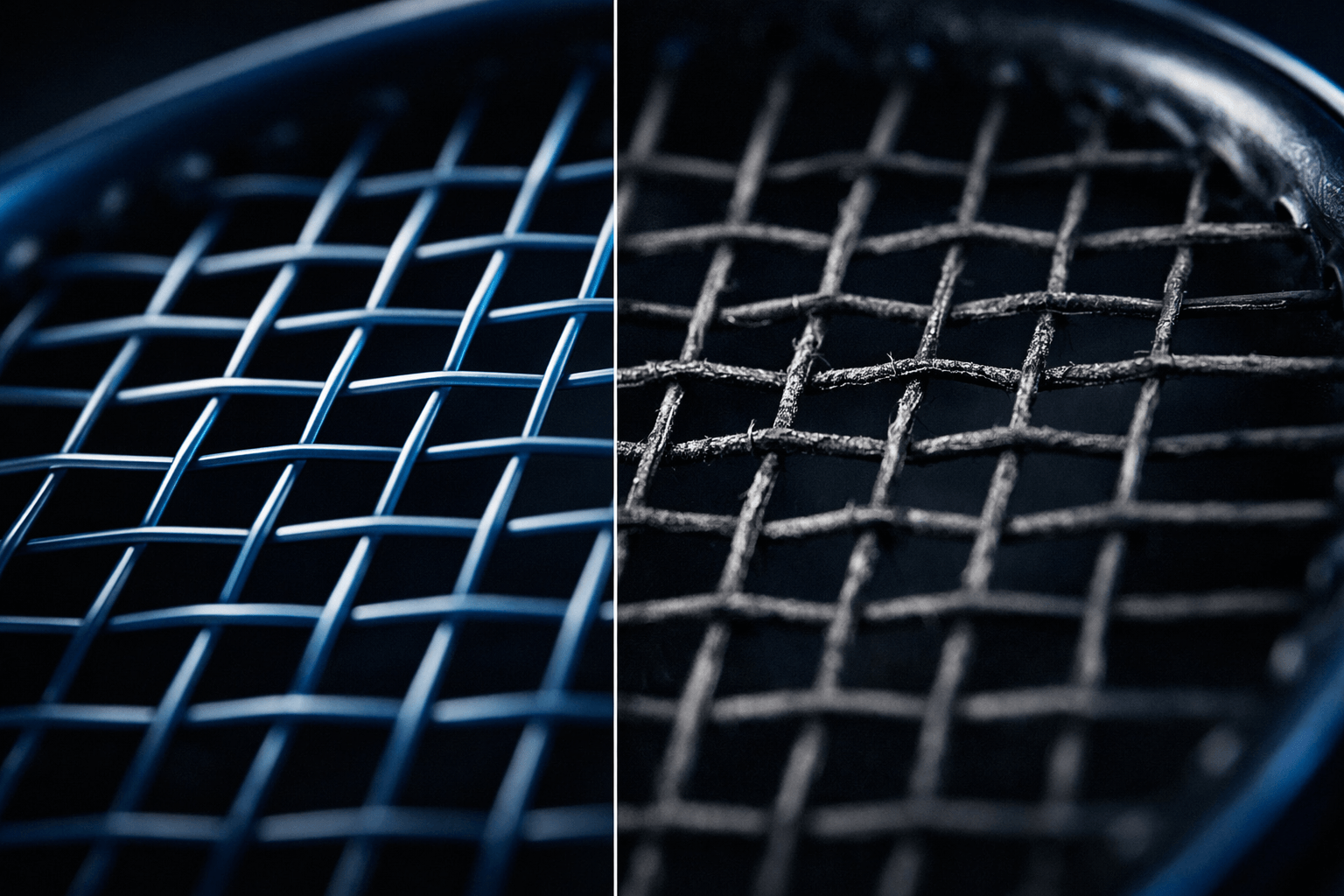
Fresh poly strings (left) vs dead poly strings (right). Surface wear and notching signal performance loss.
Why Do Poly Strings "Die"?
The loss of elasticity in polyester strings is a well-documented phenomenon called creep. Under constant tension, the polymer chains in polyester undergo permanent deformation, losing their ability to snap back to their original shape. (Rod Cross, University of Sydney)
Think of it this way: Pull a fresh rubber band and it snaps right back. But leave it stretched for a week, and it stays loose. The same thing happens to poly strings under tension inside your racket frame — except it starts within hours.
Here's how fast it happens:
| Time Elapsed | Tension Loss | Source |
|---|
| 1 minute after stringing | Up to 15 lbs | TWU, Crawford Lindsey (2013) |
| First 20 hits | Up to 20 lbs | TWU test machine measurement |
| 15 min after clamping | ~14% (28 → 24 kg) | Cross & Bower 2001, nylon |
| After three days | ~22% (28 → 21.9 kg) | Cross & Bower 2001, nylon |
Tension continues to drop after that. According to TWU research, the rate of loss is fastest initially and then gradually slows, but the cumulative loss becomes significant over time. Strings pulled at 48 lbs can feel like a completely different racket after just a few weeks.
Why Do You Lose Spin? The Death of Snapback
The biggest advantage of poly strings is snapback. When the ball contacts the string bed, the main strings slide sideways and then snap back into position, generating spin on the ball.
Think of it this way: Pluck a guitar string and it vibrates back and forth. Poly strings do the same thing when the ball hits — that movement creates spin. But dead strings are like a guitar string wrapped in tape — they barely move at all.
When snapback dies:
- You lose spin. The same swing produces less topspin, so balls don't dip as sharply.
- Balls fly long. Less spin means a higher launch angle and more outs.
- Control drops. The string bed becomes unpredictable.
Can Dead Strings Hurt Your Arm?
This is where it gets serious. Dead strings don't just hurt your game — they can hurt you.
When poly strings lose their elasticity, they lose their ability to absorb shock. The impact of every ball transfers directly through the frame, grip, wrist, and into your elbow.
Think of it this way: Fresh strings are like a trampoline — they cushion the ball softly. Dead strings are like a concrete floor. Every hit sends a jolt straight up your arm.
Tennis elbow (lateral epicondylitis) has many causes, but old poly strings are a well-known aggravating factor.
When Do Strings Actually "Die"?
You often see tables like "poly lasts X hours, multi lasts Y hours." Follow those numbers back to a source, though, and there usually isn't one.
The only time figure TWU's Crawford Lindsey gives for poly is that string death "is generally described as occurring after 2-20 hours of play" — reported convention rather than his own measurement, and not broken out by material. A tenfold range tells you how coarse this axis is.
What was actually measured isn't time. When Rod Cross's team at the University of Sydney tested 90 strings in the lab, "dying" turned out to be two physical changes.
- Perpendicular stiffness drops — dwell time lengthens and balls fly long.
- Friction between mains and crosses rises — snapback disappears, and spin goes with it.
Both are driven by impact count and impact severity. Some tension bleeds away with time alone — the creep in the table above — but what sets the pace of "going dead" is how much and how hard you hit. Twenty hours of full-swing poly and twenty hours of controlled play leave the strings in completely different condition.
So treat hours as a rough target, not a standard. Judge your own racquet by the signs below, and log when you hit them — that is how you find your actual interval.
*Lindsey C, "How Tennis Strings Go Dead", TWU Learning Center (2013) · Cross R, Lindsey C, Andruczyk D, "Laboratory testing of tennis strings", Sports Engineering 3:219–230 (2000).
How Do You Know If Your Strings Are Dead?
- Balls fly longer than usual. Same swing, more outs — classic sign of tension loss.
- Less spin than before. Topspin shots don't dip like they used to.
- Arm or elbow discomfort. Dead strings transmit more shock to your arm.
- Strings feel boardy. What was once crisp now feels stiff and unresponsive.
- Deep notching on strings. Grooves where mains and crosses intersect kill snapback.
If 2 or more apply to you, it's time to restring.
How Can You Avoid Missing Your Restring Window?
The biggest problem? Most players can't remember when they last restrung. "When did I string this?" is the most common question.
The solution is simple — track it.
- Record every restring date and tension to discover your personal replacement cycle.
- Leave quick feedback after each match — rate control, power, spin, comfort, feel, and durability to detect exactly when your strings start dying.
- Let AI analyze your patterns and tell you when it's time to restring.
If you want to track your strings systematically, try String GOAT. Log a restring in 30 seconds and get notified when your replacement cycle is approaching.