
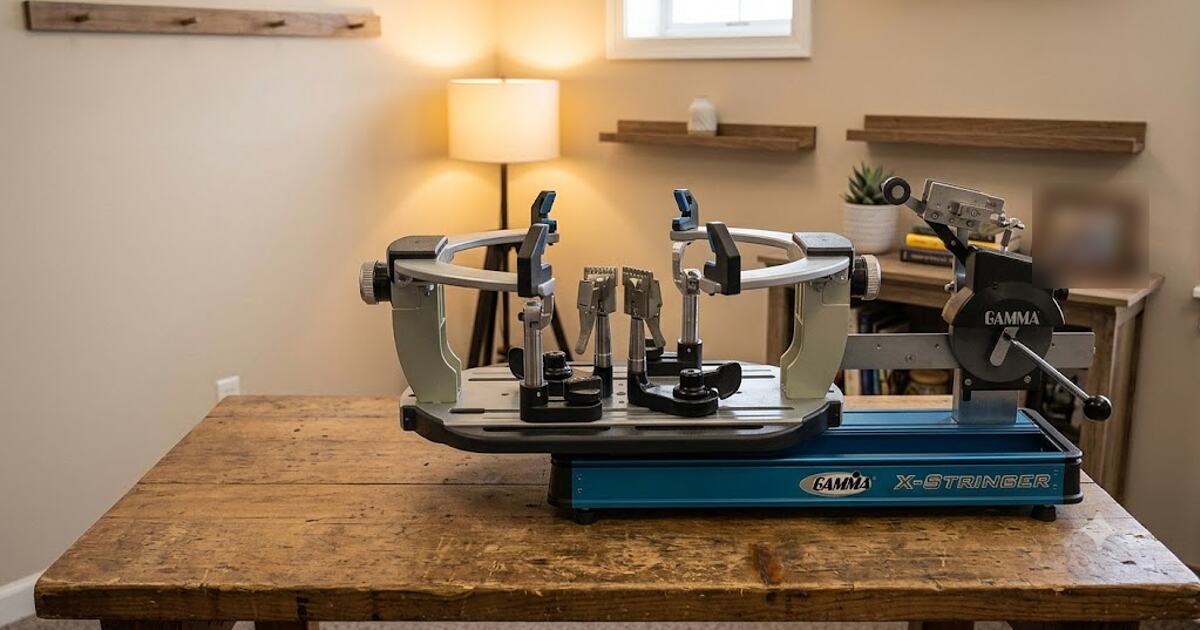
"A machine pays for itself" is true. It just does not tell you whether to buy one, because the speed at which it pays for itself varies by a factor of ten from player to player.
With the same machine, someone stringing 24 racquets a year breaks even inside a year. Someone stringing six a year takes almost four, and by then the machine is usually in a closet. So the question is not whether a machine is worth it. It is how many years it takes at your numbers.
This article is for putting your own numbers in. You only need three of them.
One formula, then the inputs
| What you want | How to get it |
|---|---|
| Savings per job | labor charge + (set price − per-job reel cost) |
| Jobs needed to break even | (machine price + tools) ÷ savings per job |
| Years to break even | jobs needed ÷ jobs you do per year |
Everything else is about making the values in those three lines accurate. One at a time.
The tensioning type matters less than the total
The first value is the machine total. Machines split into three tensioning types. Price, though, is set by clamp and frame quality rather than by type, so the three ranges overlap. Some drop-weights cost more than some cranks. These are real listed prices as of August 2026.
| Type | Price | Examples | Character |
|---|---|---|---|
| Drop-weight / counterweight | $300–1,200 | Klippermate $379, Gamma Momentum 6 $970 | Tension from a fixed weight. Slow, but repeatable |
| Crank (lockout) | $700–1,700 | Tourna 175-CS $779, 350-CS $1,675 | Hand-cranked pull. The speed-to-price compromise |
| Electronic | $1,600 and up | Tourna 550-ES $1,660, 650-ES $2,999 | Constant pull. Least time per job |
Tools sit on top of that. Many machines ship without a starting clamp, needles, cutters, or an awl, and the starting clamp alone is around $50. Putting machine price + $50 into the calculation gets you closer to reality. What goes into the break-even math is that total, not the type.
Buying used gets you the same machine one price tier lower. Just remember that whether a starting clamp is included changes the effective price, so comparing asking prices alone will mislead you.
Savings per job come from two places
The second value is what you keep on each job. Stringing yourself saves two things: the entire labor charge, and the difference between buying sets and buying a reel.
Labor, the pure work charge with string excluded, runs roughly $10 to $25 per racquet. With string bought at the shop, the total is commonly $30 to $40, stretching from $15 to $70 depending on what you put in. Big cities sit at the top of those ranges.
The string difference comes out of reel yield. A racquet takes about 11 to 12 m of string, so a 200 m reel gives 16 to 18 jobs. Divide the reel price by that and you have your per-job string cost.
| Reel | Reel price | Per job |
|---|---|---|
| Yonex Poly Tour Drive Soft 1.25 | $127 | about $7.5 |
| Solinco Hyper-G Soft 1.25 | $180 | about $10.6 |
| Babolat RPM Blast 1.30 | $299 | about $17.6 |
The same strings in sets run about $10 to $20 for poly, so switching to a reel saves roughly $3 to $10 per job. That is smaller than most people expect. The bigger half of the savings is labor, not string.
So realistic savings per job land in this band:
- $15: cheap local labor, budget string
- $20: the common case
- $30: city shop, premium poly or a hybrid
This is where almost everyone gets it wrong
The third number is how many racquets you will string in a year. It is the number people get wrong most often, and always in the same direction: too high.
What has to be counted:
- restrings after a break
- restrings where nothing broke but the string was done, because poly dies before it breaks
- each frame separately, if you play with more than one
- racquets you string for family or hitting partners
The trap is the second line, not the last one. A broken string is an event, so you remember it. Cutting out a dead string is not, so you do not. And that count tends to rise after you buy a machine, because a restring that costs you almost nothing gets done sooner. That is not bad news for the payback math. It just means a calculation built on what you spend today does not describe what you will do tomorrow.
There is only one way not to guess: count the last twelve months of restrings for real. If you have no log, six months of logging before you buy will tell you more than any calculator will.
Running the numbers
Using $430 for an entry drop-weight with tools, $900 for an entry crank, and $1,700 for an electronic machine:
| Machine total | $15 saved per job | $20 saved | $30 saved |
|---|---|---|---|
| $430 (entry drop-weight) | 29 jobs | 22 jobs | 15 jobs |
| $900 (entry crank) | 60 jobs | 45 jobs | 30 jobs |
| $1,700 (electronic) | 114 jobs | 85 jobs | 57 jobs |
Divide by your yearly volume and you get years. At $20 saved per job:
| Jobs per year | Who that is | $430 | $900 | $1,700 |
|---|---|---|---|---|
| 6 | Playing once or twice a week, one frame | 3.6 yrs | 7.5 yrs | 14.2 yrs |
| 12 | Three times a week, two frames | 1.8 yrs | 3.8 yrs | 7.1 yrs |
| 24 | Frequent breaker, or stringing for others too | 0.9 yrs | 1.9 yrs | 3.5 yrs |
Read the slope, not the individual cells. Doubling your yearly volume halves the payback, and doubling the machine price doubles it. The two axes carry equal weight. That is why the low-risk choice for a first machine is simply the cheapest one. Buy an electronic machine while stringing six racquets a year and you are looking at over fourteen years, and your frames and your string preferences will both change long before that.
Costs that are not in the table
Those numbers only count money. Four more things leave the account.
Time. Thirty to forty-five minutes per job once you are fluent, one to two hours for the first few. If a job takes you an hour, you are giving up that hour to save $20. If that trade feels bad, that is your answer. On the other hand, if dropping off and picking up a racquet costs you an hour of driving every time, stringing at home saves time as well as money. For a lot of people that round trip, not the money, is the actual reason they buy.
Failed attempts. Wasting string or not finishing the job is normal at the start. Budget two or three sets as tuition.
Money up front, and less variety. A reel means buying 200 m at once. Buy one before you know the string suits you and the next dozen-plus jobs are locked to it. If you are still auditioning strings, a reel is premature.
Space. The machine needs somewhere to live, and even a tabletop needs a cleared surface to work on.
Signs you should not buy yet
Two or more of these and it is too early:
- You do not know your restring count for the last twelve months
- That count is six or fewer
- You have not settled on a string, so you cannot buy a reel and half the savings disappear
- You are still hunting for a tension. That can be a good reason to buy a machine, but then justify it as the cost of experimenting, not as savings
- Your local labor charge is under $15
The math turns favorable quickly if any one of these is true instead: you own three or more frames, you break a string more than once every two weeks, you have started stringing for the people you play with, or the shop round trip costs you more than an hour each time.
There is a step in between
Before buying a machine there is a far cheaper move: buy the reel first and carry your own string to the shop.
You pay labor only and collect the string difference immediately. You also end up playing that one string for a dozen-plus jobs in a row, so by the time the reel is done you know two things: whether the string suits you, and how many racquets you actually string in a year. Those are two of the three inputs the machine decision needs.
If you are buying, what to look at
If the math tipped you toward buying, the next question is which one. Two decisions cut the field down before you start comparing model names.
First, the tensioning type. As the table showed, doubling the machine price doubles the payback. So the type is set by your yearly volume, not by preference. Under ten jobs a year, a drop-weight is enough: it is slow, but it is cheap and it pulls with a fixed weight, so the same setting repeats itself. Past twenty jobs the time per racquet turns into a real cost, and that is where a crank earns its price. An electronic machine starts to make sense when you are stringing for other people on a regular basis.
Second, used or new. Frames and tension heads last, so used machines keep coming up for sale. Four things to check:
- Do the clamps hold the string without slipping? If they slip, the tension you pulled is not the tension you keep
- Does the tension head stop where you set it?
- Is a starting clamp included? Buying one separately runs around $50, which is enough to flip a price comparison between listings
- Is there enough tutorial video for that specific model? Once it is yours, you are teaching yourself
No specific model recommendations here. Machines at the same price separate on clamps and mounting, and that is something you have to handle in person. What you can do is narrow the field with those two decisions, then drop the price into the payback table above and see whether the machine is worth buying at all.
The numbers are already in your log
Everything above stands on five values: machine price, labor charge, per-job reel cost, remaining reel length, and jobs per year. The first two you have to look up. The last three accumulate on their own if you are logging at all.
Register a reel in String GOAT's inventory with its purchase price and the app works out the per-job cost and how many more jobs are left in the remaining length. How many racquets you actually got out of one reel stops being an estimate and becomes your own record.
If you already bought a machine, add it under machines. Each machine counts the jobs strung on it, so hold that number against the table above and you know how far you have left to go. Jobs per year is the number people get wrong most often, and the restring history in your log turns it from memory into a record.
String GOAT is free to start. Reel inventory is a subscription feature and the free plan covers a single frame, but registering a machine and logging restrings is where you begin, and that count is the most important number in this calculation.