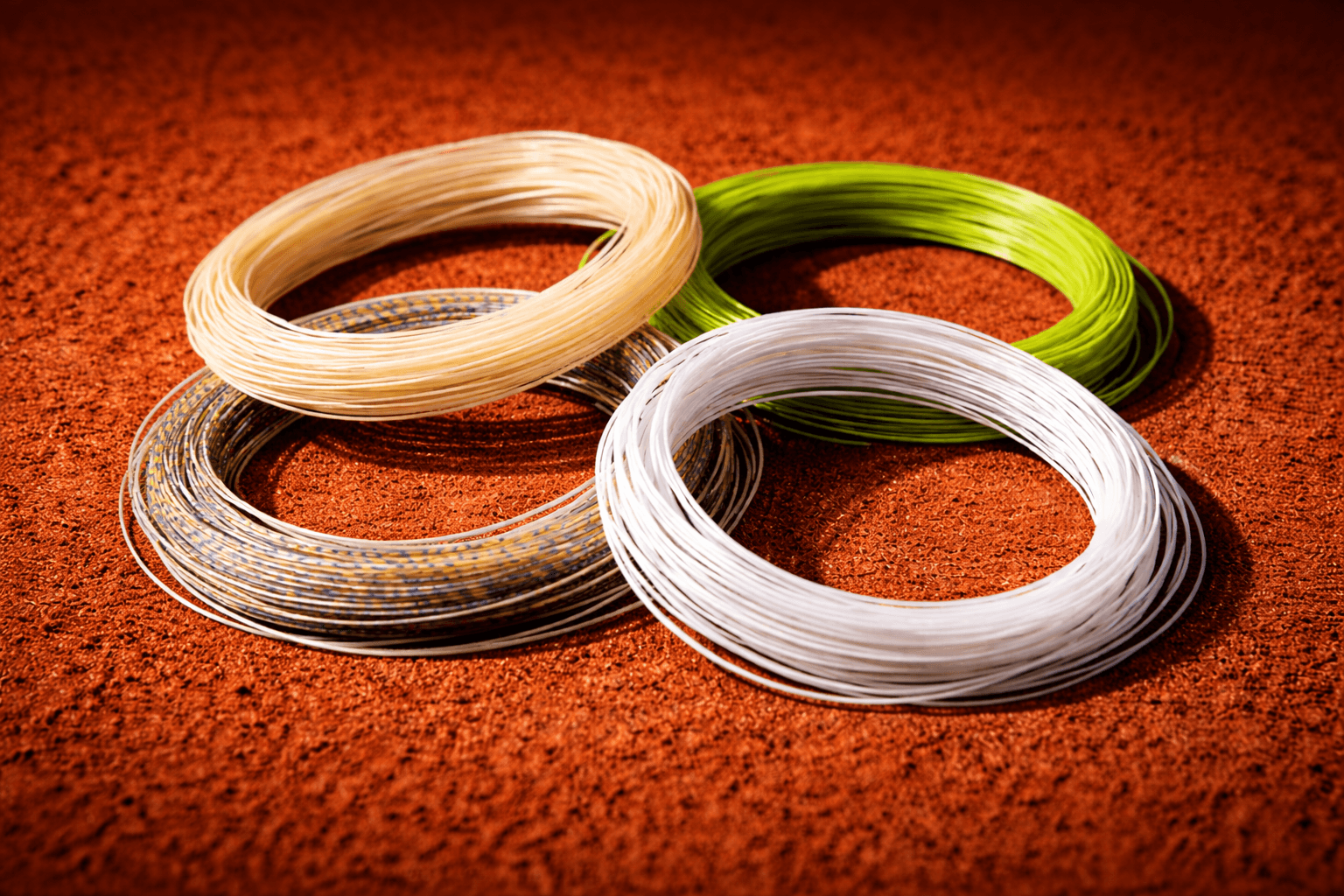
"What strings do you use?" It's one of the most common questions in tennis communities. Yet even recommended strings feel different every time, the same name comes with wildly different price tags, and explaining the difference between 'poly' and 'multi' seems impossible. The reason is simple — different materials mean fundamentally different physical properties.
In this guide, we'll break down the 4 tennis string materials (natural gut, polyester, multifilament, and synthetic gut) — how each is constructed, and why they perform differently — backed by science.
Why Are There So Many String Types?
Tennis strings fall into 4 material categories.
| Material | Structure | One-Line Summary |
|---|
| Natural Gut | Cow intestine collagen fibers | The original — unmatched elasticity |
| Polyester | Synthetic resin monofilament | The modern workhorse — spin & control |
| Multifilament | Hundreds to thousands of nylon fibers | Gut-like feel in a synthetic package |
| Synthetic Gut | Single nylon core + outer wrap | The reliable all-rounder |
Think of it this way: just like shoes come in running, basketball, and soccer varieties, strings are designed with different materials and structures depending on which performance aspect matters most. A cushioned shoe is comfortable but heavy; a light shoe is fast but tough on the feet. Strings work the same way.
Tennis strings on a clay court
Let's look at each material in detail.
Natural Gut — The Original and Finest
Natural gut is where tennis strings began. In 1875, Babolat made the first racket string from sheep intestines. Today, strings are made from collagen fibers extracted from the serosa (intestinal lining) of cows. About 2–3 cows are needed for a single set.
The manufacturing process is equally special: cleaning → inspection (removing defects) → chemical curing → twisting → drying (3–6 weeks) → coating — mostly done by hand, taking weeks to complete.
Think of it this way: natural gut is the 'wagyu beef of strings.' Made from natural materials with extensive handcrafting, it's expensive — but its performance, especially elasticity and comfort, remains in a league that synthetic materials haven't fully matched.
What makes natural gut special lies in the molecular structure of collagen. Collagen consists of three protein chains twisted into a 'triple helix' structure. This structure gives it exceptional ability to stretch under force and return precisely to its original shape — known as elastic resilience. This is why natural gut maintains tension longer and cushions the ball more gently than any synthetic.
Think of it this way: imagine a quality spring. A good spring returns to its exact height even after being compressed thousands of times. Collagen's helical structure acts as that 'perfect spring.'
| Pros | Cons |
|---|
| Best elasticity — excellent power and comfort | High price ($40–60+ per set) |
| Best tension maintenance | Sensitive to moisture — caution on rainy days |
| Stays comfortable even at high tension | Less durable than polyester |
| Lowest arm stress | Less spin generation than poly |
*Natural gut's tension maintenance advantage stems from collagen's high elastic resilience, confirmed by TWU (Tennis Warehouse University) test data.
Polyester — The Modern Game's Workhorse
Polyester strings are made by melting polyethylene terephthalate (PET) resin and extruding it into a single thick monofilament. The molten resin is pushed through a fine die, cooled in water, then stretched by rollers to achieve the desired gauge and strength.
It is part of the shift from natural gut to synthetic materials such as nylon and polyester (Allen, Choppin & Knudson, Sports Engineering, 2015). Neither for the tour nor for the wider market could a reliable survey putting numbers on material share be found.
Think of it this way: it's the same family of plastic used to make PET bottles — literally, the 'PET' is the same material. This plastic is drawn thin and long to become a tennis string.
Polyester excels at spin because of its low surface friction. The slick surface allows main strings (vertical) to slide sideways when the ball pushes them, then snap back to position quickly — this snapback effect is what imparts spin to the ball.
However, polyester's biggest weakness is tension loss speed. Under constant tension, polyester molecular chains undergo permanent deformation called creep. In a University of Sydney experiment, a nylon string pulled to 28 kg and then clamped fell to about 24 kg within 15 minutes, shed another 1~2 kg over the next 24 hours, and sat at 21.9 kg after three days. The same paper only records that polyester loses tension faster than nylon — it gives no figure for poly. (Cross & Bower, Sports Engineering 4:165–175, 2001)
What Is Co-Polyester?
Most products sold as 'poly strings' today are actually co-polyesters. These blend pure PET with additives like resins, plasticizers, and elastomers to make the string softer and more elastic than pure poly. For example, Babolat RPM Blast Rough contains crosslinked silicone.
Think of it this way: if pure poly is 'rigid plastic,' co-poly is 'plastic mixed with a bit of rubber.' Slightly more flexible and easier on the arm, while keeping the core characteristics (spin, control) intact.
| Pros | Cons |
|---|
| Best spin generation (snapback) | Fastest tension loss (creep) |
| High control and precision | Harsh on the arm — high stiffness |
| Excellent durability | Least power |
| Affordable ($5–15 per set) | Dull touch and feel |
*Querying 480 polyester strings in the TWU String Performance Database (August 2026) returned a stiffness range of 136–314 lb/in, with 80% falling between 180 and 240 lb/in — noticeably stiffer than other materials at the same tension. The database is updated continuously, so the figures depend on when you query it.
Multifilament — Recreating the Gut Feel
Multifilament strings are made by twisting or braiding hundreds to thousands of nylon microfibers into a single string. This bundled structure delivers elasticity and shock absorption similar to natural gut.
Think of it this way: a single thread breaks easily, but hundreds of threads twisted into a rope are strong yet flexible. Multifilament applies this principle to strings. It's fundamentally different from polyester (one thick rod).
Multifilament feels soft because of micro-movement between fibers. When the ball contacts the string bed, hundreds to thousands of fibers each shift slightly, dispersing impact energy. A polyester monofilament, being a single mass, absorbs the impact rigidly — hence the stiff feel.
Think of it this way: compare a solid metal rod and a bundle of wires of the same thickness. The rod doesn't bend and transmits shock directly; the wire bundle flexes slightly, absorbing impact. Poly = rod, multi = wire bundle.
| Pros | Cons |
|---|
| Excellent shock absorption — easy on the arm | Less durable than polyester |
| Soft, gut-like feel | Less spin than polyester |
| Good power (high elasticity) | Doesn't quite match gut performance |
| Better tension maintenance than poly | More expensive than synthetic gut |
Synthetic Gut — The Reliable All-Rounder
Synthetic gut has a single nylon core wrapped with outer filaments. Despite the 'gut' in its name, it has nothing to do with animal materials. It's a nylon-based synthetic string, and the one most often fitted at the factory on new racquets — the most common type available.
Think of it this way: synthetic gut is the 'sneaker of strings.' Nothing spectacular, but it does everything reasonably well at a fair price. The string that comes pre-installed on most new rackets is usually synthetic gut.
Structurally, what sets it apart from multifilament is that the core is a single thick nylon filament. While multifilament has a core of hundreds to thousands of fibers, synthetic gut wraps outer layers around one solid core. The wrap helps maintain tension and protects the core from friction.
| Pros | Cons |
|---|
| Most affordable ($3–10 per set) | All performance aspects are 'average' |
| Balanced power, control, and comfort | Less spin than polyester |
| Versatile — great for beginners | May not satisfy advanced players |
| Available everywhere | Not as soft as multifilament |
All 4 Materials at a Glance
Here's everything in one comparison table.
| Category | Natural Gut | Polyester | Multifilament | Synthetic Gut |
|---|
| Material | Cow serosa collagen | PET resin | Nylon fiber bundle | Nylon core + wrap |
| Power | High | Low | Medium–High | Medium |
| Control | Medium–High | High | Medium | Medium |
| Spin | Medium | High | Medium | Medium |
| Comfort | Best | Low | High | Medium |
| Durability | Medium | High | Low–Medium | Medium |
| Tension Maintenance | Best | Worst | Good | Medium |
| Price Range | $40–60+ | $5–15 | $10–25 | $3–10 |
*Based on TWU test data, manufacturer recommendations, and USRSA guidelines. Performance varies by brand, gauge, and construction within the same material category.
Each type's characteristics are just a starting point. Even with the same co-poly, how it actually feels on your racket and with your swing is something you only find out by stringing it up and playing with it. String GOAT logs the string type with every record and collects ratings across 6 categories — control, power, spin, comfort, feel, and durability — so you can later compare how you actually felt about each type.
Which String Is Right for You?
Choosing a string comes down to "what matters most to you."
| Your Situation | Recommended | Why |
|---|
| Just starting tennis | Synthetic Gut | Affordable and balanced — a great starting point when you don't know your preferences yet |
| Frequent arm pain | Multifilament or Natural Gut | Superior shock absorption minimizes arm stress |
| Spin-heavy intermediate+ player | Polyester (Co-poly) | Maximum spin via snapback — requires fast swings |
| Want both power and comfort | Multifilament | Gut-like elasticity at a reasonable price |
| Want the best regardless of cost | Natural Gut | Top-tier elasticity, tension maintenance, and comfort |
| Durability is the top priority | Polyester | Most durable and affordable |
| Want to combine the best of both | Hybrid (2-material setup) | See section below |
The Hybrid Option
A hybrid setup uses different materials for the mains (vertical) and crosses (horizontal). Since the mains set most of the overall feel, the main string material defines the setup's character.
The two most popular combinations:
- Natural Gut (mains) + Poly (crosses): Roger Federer's famous setup — gut's power and comfort as the foundation, with poly adding durability.
- Poly (mains) + Multifilament (crosses): Poly's spin and control as the base, with multi softening the impact. A cost-effective favorite among club players.
Hybrid setups are a major topic on their own. Check out our detailed combination guide in the Complete Guide to Hybrid Strings.
The Answer Is in Your Records
We've explained each material's characteristics, but ultimately even within the same material, performance varies by brand and product. Polyester stiffness alone spans 136 to 314 lb/in across the 480 strings in the TWU database — over a 2x difference — and multifilament feel varies widely between products too.
That's why what matters most is trying strings yourself and keeping records. "This string at this tension gave me great power / hurt my arm / generated amazing spin" — building systematic feedback like this lets you find your optimal setup through data.
Recording strings and reviewing feedback in the String GOAT app
With the String GOAT app, log your string type, tension, and date in 30 seconds — then rate power, control, spin, comfort, feel, and durability after play, and AI analyzes your patterns. When trying different strings, having records makes comparison possible.