When the stringer asks "How many pounds?", many players freeze. The typical response is "same as last time" or "just do the usual." It makes perfect sense to leave the stringing work to a professional stringer. But which tension to choose and why — that's something you should know. It helps you communicate precisely with your stringer and maintain consistent setups every time.
In this guide, we'll explain how tension affects power, control, spin, and arm health, and how to find the tension that's right for you — backed by science.
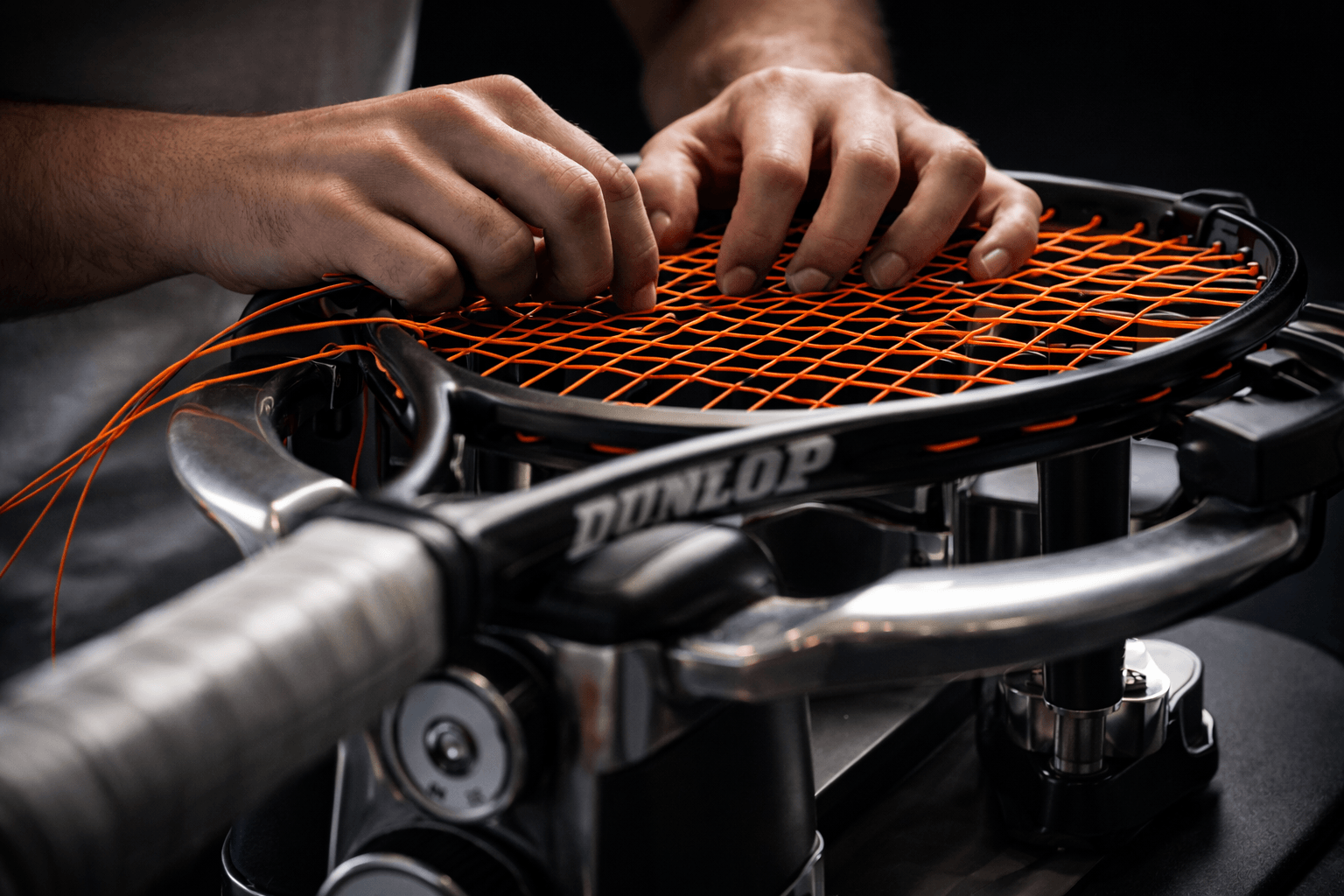
A racket secured in a stringing machine. The tension number your stringer dials in directly impacts your play.
What Is Tension?
Tension is the force at which the strings are pulled tight across the racket frame. It's measured in pounds (lbs) or kilograms (kg), and most rackets support a range of 40–70 lbs. Many players string between 48 and 60 lbs.
Every racket has a recommended tension range printed on the frame. For example, if it says "50–60 lbs," you choose within that range based on the characteristics you want.
In simple terms: Tension is like the elasticity of a trampoline. A tightly stretched trampoline won't bounce you very high. A loosely set trampoline sinks deep and launches you high. Strings work the same way.
The Half-True Formula — "Higher = Control, Lower = Power"
This formula is correct. But if you don't understand why, you can't find the tension that works for you.
The key concept is dwell time — the time the ball stays in contact with the string bed, roughly 3–5 milliseconds (ms). (Crawford Lindsey, Tennis Warehouse University)
| Tension | String Behavior | Result |
|---|
| High tension | Strings deflect less → shorter dwell time | Less power, crisper feel, more control |
| Low tension | Strings deflect more → longer dwell time | More power, softer feel, less control |
*The relationship between dwell time and power is based on TWU and Rod Cross research (University of Sydney). Actual differences vary with string material, gauge, and racket stiffness.
In simple terms: Lower tension "holds" the ball on the string bed longer before releasing it, producing greater rebound energy. Higher tension deflects the ball quickly, making it easier to direct the ball where you want.
An important point: the difference is smaller than you'd expect. When 41 players hit strokes on court with rackets strung at 40, 51 and 62 lb, the rebound speed gap between the lowest and highest tension — a 22 lb spread — was only about 3%. Between 40 and 51 lb there was effectively no difference at all (108.1 vs 107.3 km/h). (Bower & Cross, Journal of Sports Sciences, 2005) Unless you're comparing extreme tension differences, swing speed has a far greater impact on power than tension does.
How Tension Affects Spin
When it comes to spin, tension works a bit differently. The key to spin is snapback — when the ball pushes the main strings aside as it slides across the string bed, and the strings snap back into place, imparting spin on the ball.
Lower tension → strings move more freely → greater snapback distance → more spin
At lower tensions, the snapback effect is more pronounced, which helps generate spin. This effect is especially noticeable with slippery-surfaced strings like polyester.
In simple terms: It's similar to dribbling a basketball on a cushioned mat versus concrete — the softer surface holds the ball a beat longer. At lower tension, the string bed behaves the same way: the ball stays in contact longer and rotates more.
Recommended Tension by String Type
Recommended tension depends on the string material. At the same 55 lbs, polyester and natural gut feel nothing alike.
But a "recommended tension range" belongs to the racquet, not the string. The ERSA study guide puts it plainly — "The recommended tension range for a racquet will be found in the throat of the racquet because even with the same model, a 4½-inch grip will have a higher recommended tension range than a 4¼-inch grip." (ERSA Study Guide 2017, p.25) The range printed in the throat of the frame is the reference; the material only tells you which end of that range to lean toward.
- Polyester — the stiffest, so the lower end. Adding high tension on top of a stiff string compounds the impact.
- Synthetic gut and multifilament — the middle. Softer than poly, so a little higher still absorbs shock.
- Natural gut — the most elastic, so it keeps power and comfort even at the upper end.
*The stiffness order follows the ERSA guide (aramid > monofilament > nylon > natural gut). We leave out absolute per-material tension numbers deliberately: the recommended range differs by racket (even by grip size), so a one-size-per-material number can push you outside your own frame's printed range. The material only picks the direction within that range.
Polyester is inherently stiff, so adding high tension compounds the shock, increasing arm stress. Players who prioritize arm health or spin should lean toward the lower end of the tension range.
What Tension Is Right for Me?
Here's a starting-point guide based on player type.
| Player Type | Recommended Direction | Reason |
|---|
| Beginner lacking power | Lower tension (bottom of recommended range) | Leverage the string bed's rebound energy |
| Balls keep flying out | Raise tension by 2–4 lbs | Improve control |
| Elbow or wrist pain | Toward the bottom of the range, near 45 lbs | Increase shock absorption |
| Spin-heavy player | Lower tension + polyester | Maximize snapback |
| Flat hard hitter | Mid to high tension | Crisp feel and control |
| Serve & volley tactician | Mid to high tension | Prioritize touch and feel |
*The adjustment sizes in this table are stringer rules of thumb, not measured values. Use them as a starting point and correct with your own records. Why 45 lbs is the reference for arm pain is covered in the tennis elbow guide.
This table is just a starting point. Individual differences are significant, so you need to test and record your results to find your own optimal tension.
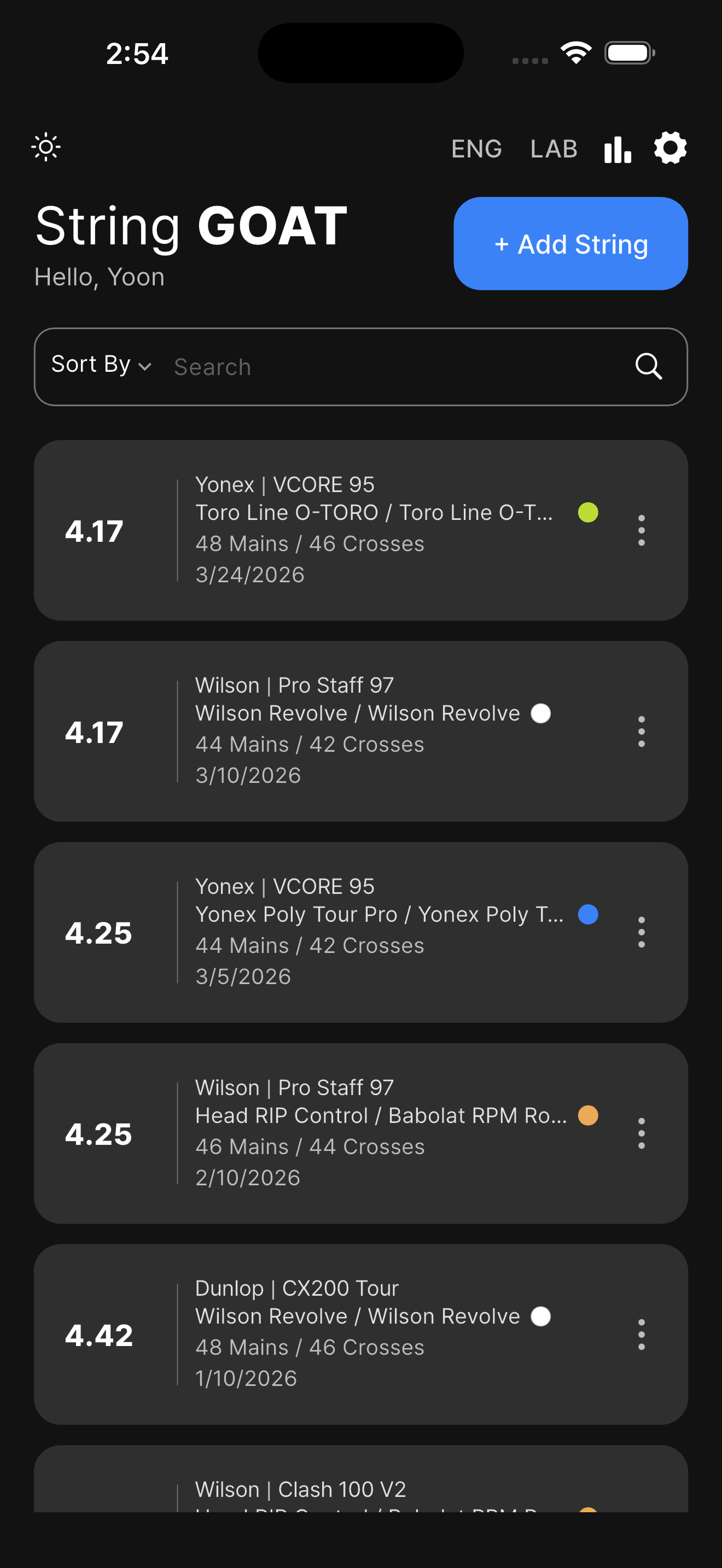
Tension isn't something you set once and leave — it's something you keep adjusting. String GOAT logs main and cross tension separately, and shows your measured values (absolute tension, DT, subjective score) in chronological order. Based on the average tension of your accumulated records, it also suggests how many lbs to adjust the mains and crosses by, depending on whether you want to move toward control, power, or comfort.
How Temperature Affects Tension
Tension isn't a fixed value. When the temperature drops, strings get stiffer and play firmer; when it rises, they soften. In lab testing, warming strings from 0°C to 40°C lowered stringbed stiffness by 3–19% in six of the seven strings tested, while one actually got stiffer by 2%. The authors concluded that gut and nylon are more thermally reactive in stiffness than polyester and kevlar (Lindsey & Cross, 2016).
In simple terms: It's the same reason a rubber band gets stiff and less stretchy in the cold. When it's cold, the polymer molecules in the string slow down and the material becomes more rigid.
- Winter outdoors (below 10°C / 50°F): Consider stringing lower than usual
- Summer outdoors (above 30°C / 86°F): Consider stringing higher, or keep as is
- Indoor courts: Temperature is stable, so no adjustment needed
How much to adjust has never been measured. What the lab measured is a change in stiffness, not a conversion into pounds. Figures like 2–3 lbs circulate widely but are industry lore, not experimental results. The only way to find your own number is to log your setups across seasons and courts.
Professional players fine-tune for this, but for recreational players, it's enough to be aware of the effect and understand why "the ball feels different today."
Why Recording Your Tension Matters
The biggest problem is that people don't remember their tension. When did you last restring? How many pounds? Did it feel good or bad? Most people can't recall.
Tension involves many variables. Even with the same 55 lbs:
- A different string type gives an entirely different feel
- Even within polyester, elasticity and stiffness vary by brand and model
- Hybrid setups (different strings for mains and crosses) — with roughly 300 strings on the market, that's nearly 90,000 possible permutations — produce the widest variation in feel at identical tensions
- Different head sizes change the feel (the same lbs feels softer on a larger head)
- Different weather conditions change the feel
- The stringer's equipment and technique can alter the actual tension
*Based on approximately 300 commercially available tennis strings worldwide, ordered 2-permutations for mains and crosses: 300 × 299 = 89,700 combinations. Including gauge variations, the number exceeds hundreds of thousands.
With all these variables, keeping records is essential if you want to find your optimal tension through data. Systematic tracking leads you to your own formula: "With this string, this racket, in this weather — 52 lbs is the sweet spot."
With the String GOAT app, log your tension, string type, date, and weather in 30 seconds — then leave feedback on power, control, spin, comfort, feel, and durability after playing, and the AI will analyze your patterns. It's the fastest way to find your optimal tension.