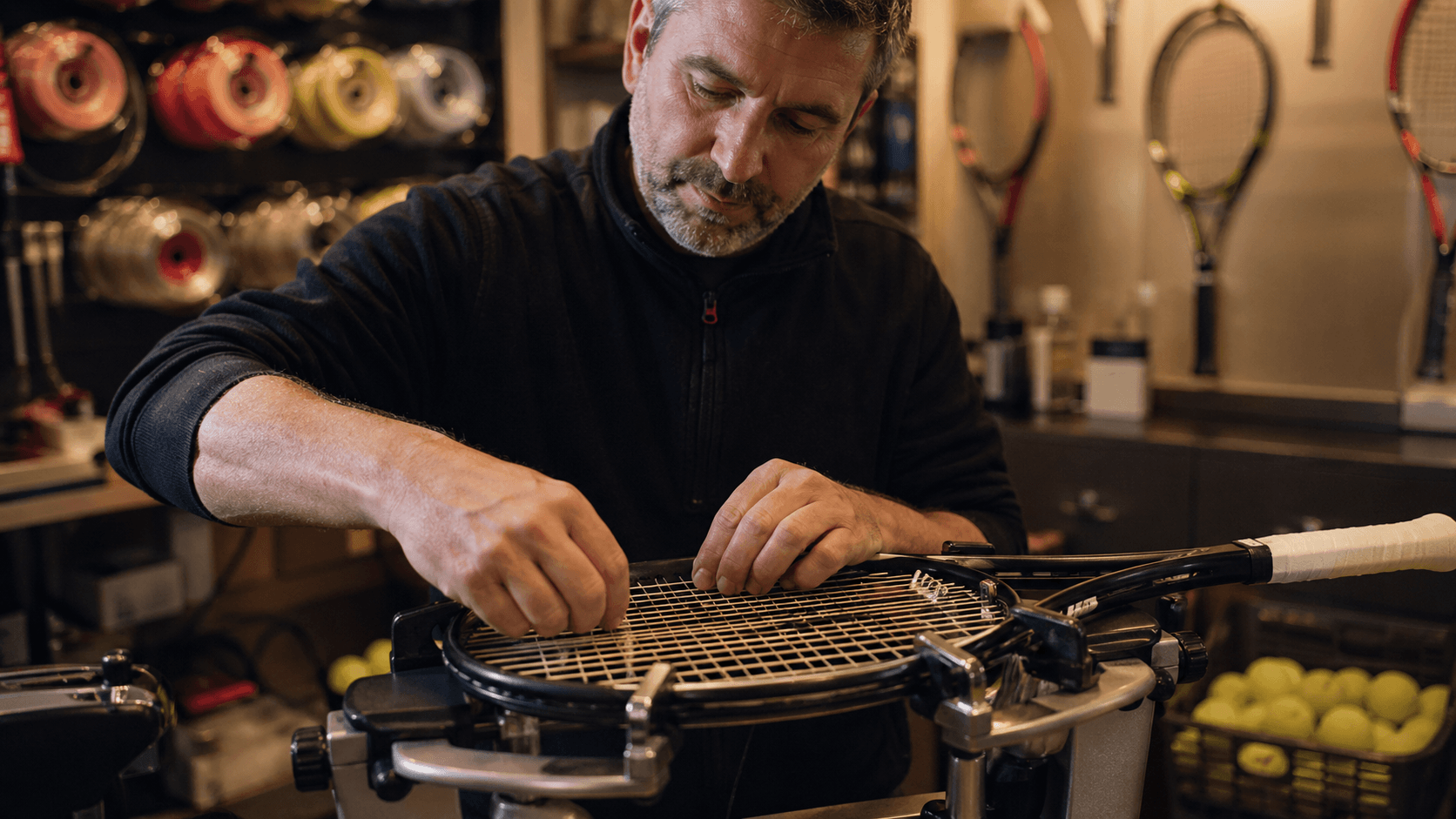
When choosing tennis strings, you'll hear plenty of advice: "go with natural gut," "try poly." But there's another approach — using different materials for the mains (vertical) and crosses (horizontal). This is called a hybrid setup.
Hybrids have been a staple on the pro tour for years, and "what should I use for mains/crosses?" is one of the most common questions in player communities. This is the article we promised in our string types guide.
This guide is based on ERSA (European Racquet Stringers Association) and USRSA (United States Racquet Stringers Association) educational materials, covering how hybrids work, three pairing strategies, tension setup, and common myths.
Mains vs Crosses — Different Roles
To understand hybrids, you first need to understand the role difference between mains and crosses.
| String | Role | Influence |
|---|
| Main strings (vertical) | Feel, spin, power | ~70% |
| Cross strings (horizontal) | Stringbed stability, durability | ~30% |
*This is an industry rule of thumb (the "70/30 rule"). No association document or study measuring the split could be found — stringers agree on the direction, but the numbers themselves have no measured basis. They also shift with racket, string pattern, and tension.
In plain terms: the mains set the character, the crosses fine-tune it. The core idea behind hybrids is to put the material you want for feel in the mains, and compensate for its weaknesses with the crosses.
This ratio has an important implication. Changing only the crosses won't transform the racket's character — though it is an effective lever for adjusting stiffness and arm comfort. Conversely, changing the main string material — even with the same crosses — can make the racket feel entirely different.
Three Hybrid Strategies
Hybrid setups can be grouped into three main strategies by purpose. There is no single "best" combination — it depends on what you prioritize.
| Strategy | Mains | Crosses | Goal |
|---|
| Power + comfort | Natural gut | Co-poly | Gut's elasticity + poly's durability |
| Control + arm protection | Co-poly | Multifilament | Poly's spin/control + multi's shock absorption |
| Control retention | Co-poly | Soft co-poly | Maintain control feel + slight comfort gain |
*These are the three strategies laid out in this article; many other combinations are possible.
Let's look at each one.
Gut Mains + Co-Poly Crosses — "The Premium Choice"
This setup places natural gut in the mains and co-poly in the crosses. Roger Federer famously used this configuration throughout much of his career, and Wilson commercialized it as "Champion's Choice" (Wilson Natural Gut mains + Luxilon ALU Power Rough crosses).
The appeal is clear:
- Mains (gut) determine most of the feel, so you get gut's exceptional energy return (elasticity) and comfort as the baseline character.
- Crosses (co-poly) compensate for gut's durability weakness. They reduce notching (groove-cutting from friction) that occurs when gut crosses against gut.
However, there's a common misconception worth addressing.
"Gut holds tension longer" — the reason is often misunderstood. ERSA educational materials draw a clear distinction: gut feels "alive" longer largely because of its superior elastic return (the ability to bounce the ball back with energy). That said, in terms of actual tension retention, natural gut is the best of all string materials, while polyester loses tension the fastest. Co-poly has improved its tension retention over older polyester, but it still doesn't hold tension as long as natural gut.
In plain terms: a gut-main hybrid keeps its "lively feel" longer thanks to elastic return, and it also holds its tension number better than poly.
Honest downsides to consider:
- Cost. A half-set of natural gut costs more than a full set of co-poly.
- Moisture sensitivity. Gut absorbs water in rain or high humidity, degrading performance rapidly. Even coated versions shouldn't be exposed for extended periods.
- Not for everyone. Players with very fast, powerful swings may find gut's high power output makes control more difficult.
If cost is a concern or you frequently play in humid conditions, the co-poly main hybrid below may be a more practical choice.
Co-Poly Mains + Multi/Soft Co-Poly Crosses — "The Practical Choice"
This is the hybrid type most recreational players try first. There are two variations.
Variation 1: Co-poly mains + multifilament crosses
Keeps co-poly in the mains for spin and control, while lowering overall stringbed stiffness with multifilament crosses.
- Upside: Reduced arm stress compared to full co-poly. The ERSA arm health protocol recommends "using a softer or multifilament string."
- Realistic expectations: It won't feel as soft as full multifilament. The mains are still co-poly, and that stiffness dominates. But it's noticeably softer than full co-poly.
- Watch out: Multi crosses may wear faster due to notching against co-poly mains. The replacement timing of your co-poly mains still matters — if the mains die first, fresh crosses won't save the setup.
Variation 2: Co-poly mains + soft co-poly crosses
Both sides are co-poly family, but the crosses use a softer compound (e.g., Solinco Confidential, Luxilon Smart, Babolat RPM Power).
- Upside: Maintains the control feel of co-poly while adding a touch of comfort. Less concern about material compatibility.
- Realistic expectations: Less arm relief than multi crosses. Best for players who don't mind co-poly but want it "just a little softer."
If your arm is hurting, check the tennis elbow guide first. A hybrid is one possible solution, not a cure-all.
Kevlar/Aramid Hybrid — "The String Breaker's Solution"
This setup serves a different purpose from typical hybrids. It's a specialized configuration for chronic string breakers.
Aramid (Kevlar®, Technora®, etc.) is the stiffest material of all string types. According to ERSA/USRSA educational materials (2012), it shows "about 3% elongation at 60 pounds" — meaning it barely stretches at all. Even co-poly, which most players consider stiff, is significantly more elastic than aramid.
Why aramid mains + nylon (or multi) crosses work for breakers:
- ERSA/USRSA (2012) describes this combination as "probably the most effective hybrid available for reducing frictional notching." Aramid's extreme tensile strength dramatically reduces the groove-cutting that causes strings to snap.
- ERSA recommends "lowering tension about 10% to compensate for lesser elongation" when using aramid.
But there's a significant cost.
- Harshest on the arm. ERSA classifies aramid arm stress as "VERY HIGH" — even when used only as mains in a hybrid.
- Pure aramid stringing is virtually never used; it's always mains-only in a hybrid setup.
In plain terms: an aramid hybrid is the last resort for "I break strings twice a month and can't stop playing." Consider it only if you have no arm issues and durability is your top priority.
Hybrids have so many possible combinations that without records, you end up relying on memory. String GOAT stores mains and crosses separately — down to brand, model, type, tension, and gauge — and suggests which combination to try next based on your accumulated records. Combinations you've already tried are flagged, so you don't repeat the same experiment.
Tension Setup — Different for Mains and Crosses?
The most common question from first-time hybrid users: "Should I set mains and crosses at the same tension?"
The ERSA Study Guide (2017) states:
"It's not uncommon for a racquet to have main strings with 55 pounds of tension and crosses with 40 pounds."
The quote itself says nothing about the cause. In practice two things overlap. Cross strings naturally end up at lower tension than specified because of friction drag as they pass through the mains. This is a physical phenomenon that occurs with all strings, and it's normal. On top of that, stringers sometimes do set the two deliberately differently to account for the materials.
With hybrids, material differences add another layer. Setting both at 50 lbs will feel very different depending on what materials you're combining. A stiffer material feels firmer at the same tension number; a softer one feels more forgiving.
So there is no standardized "correct tension" for hybrids. But there is a practical approach:
- Starting point: Begin at the middle of your racket's recommended tension range.
- Change one variable at a time: Once you've settled on a string combination, adjust tension in 2–3 lb increments and track results.
- Consult your stringer: An experienced stringer can suggest tension adjustments based on your specific material combination.
For tension fundamentals, see the tension guide.
Three Common Myths
Let's address three persistent misconceptions about hybrids.
1. "Gut mains last only because they do not lose tension"
As covered above, the main reason gut lasts is its elastic return (energy given back to the ball). Even so, natural gut also retains tension best of all materials, while polyester loses it fastest; co-poly has improved over older polyester but still doesn't match gut. "Feels alive longer" (elastic return) and "holds its tension number" are worth keeping separate.
2. "A hybrid combines the best of both materials"
Appealing idea, but the reality is that the mains set most of the character. The crosses' contribution is more limited than the mains'. A hybrid isn't the "average" of two materials — it's more accurately described as the main string's character with a slight adjustment from the crosses. A co-poly main + multi cross hybrid is "co-poly with a multi touch," not "halfway between co-poly and multi."
3. "You can mix any two strings"
Technically any combination is possible, but practically, the three strategies above are the proven ones. Combinations with extreme stiffness mismatches (e.g., aramid mains + gut crosses) or contradictory goals may not deliver the expected results. If you're new to hybrids, start with a proven combination and experiment with variations as you gain experience.
Finding Your Ideal Hybrid — The Answer Is in Your Records
Hybrids offer a wide range of combinations, which makes it easy to conclude "I tried a hybrid once and it wasn't for me." But even within the same gut + co-poly pairing, changing tension by just 3 lbs can deliver an entirely different feel.
The key is keeping comparable records. Log the materials, tension, and date, then leave feedback on power, control, spin, and comfort after each session. By the third restring, patterns start to emerge.
String GOAT lets you log a string record in 30 seconds — under a minute even with 6-axis feedback (power, control, spin, comfort, feel, durability), and the AI analyzes your patterns to suggest the next setup. When your hybrid usage ratio exceeds 50%, the AI automatically shifts to arm-health-prioritized recommendations.
The best hybrid setup isn't in someone else's recommendation — it's in your own records.